
李博是一位画家、多媒体艺术家兼音乐人。他说,他永远忘不了2013年那一声“啊”——来自一个叫杨微微的听障女孩的孤零零的一声,“完全淹没了我的心”。
那一年,女孩杨微微后来成为“无声合唱团”的核心成员,一个若没有她这声“啊”便不会诞生、并完全由听障儿童组成的团队。
Li Bo, a multimedia artist and musician, said he would never forget the sound of a deaf girl's "ah" as — "a lone utterance that flooded my heart completely".
That was in 2013. The girl, Yang Weiwei, has since become a core member of Li Bo's Silence Choir — a group that would never have existed without that one sound, and one composed entirely of deaf children.
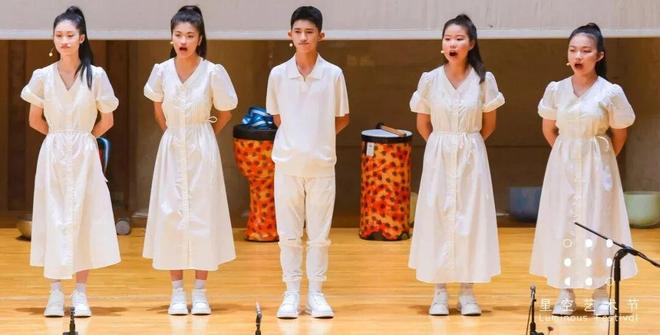
无声合唱团今天9月份在北京中山公园音乐堂演出
今年9月,合唱团登上了北京中山公园音乐堂的舞台。演出伊始,音乐轻柔而空灵,仿佛从他们曾经训练过的那片遥远山岭被风带来。忽然,一颗石子落入水面——一个孩子的第一声“啊”响起。随后,另一声、再一声,如点滴、如细流,最终汇成奔涌不息的洪流。
“真正的平等,源于心与心的共鸣。”李博说。
In September, the choir took the stage at Beijing's Forbidden City Concert Hall. As the performance began, the music rose — soft and ethereal — as if carried from the distant mountains where the members had once trained. Then, a single stone fell into the musical waters: the first "ah" of a lone voice. One by one, others joined — a continuous drip, a trickle, a stream, and then a gushing current.
"True equality originates from the resonance of the heart," Li said.
跨越山路,也跨越隔膜
对李博与他的音乐搭档张咏而言,从北京到这个女孩子所在的学校,既是一段真实的跋涉,也是一段精神的旅程。
“我们坐了飞机、火车,两趟大巴,最后又搭上摩托车才到达。” 张咏回忆说。
Yet it was a long journey — both literal and metaphorical — for Li and his fellow musician Zhang Yong, co-founders of the choir, to come to see the deaf singers as truly equal.
"We took a plane, a train, two buses, and finally a motorcycle ride to reach the school, where I first met the girl," recalled Zhang, who is based in Beijing.
这所学校藏在广西凌云县的大山腹地,专门为当地有不同残障的孩子而建。
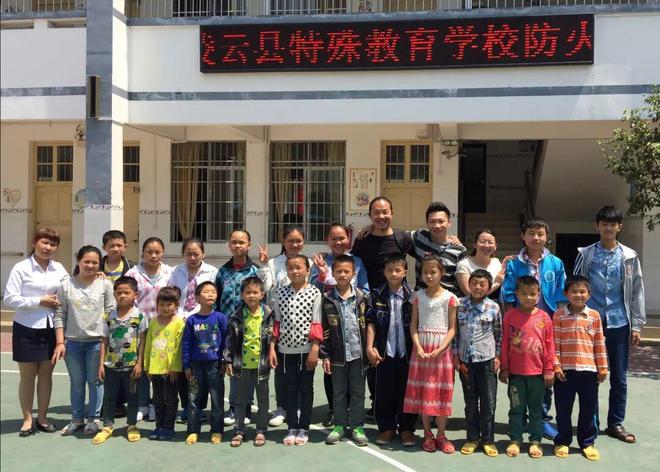
李博(后排右四)和张咏(后排右五)于2014年和广西凌云县特殊教育学校的孩子们在一起
“凌云”意为“云之上”,但孩子们的希望,却总难达到那么高。大门内的他们在自己的节奏中生活、行动,有些孩子对门外那些能听见的人的世界感到陌生和害怕。
Nestled deep in the mountains of Lingyun county in South China's Guangxi Zhuang autonomous region, the school was built specifically for local children with various disabilities.
Lingyun means "above the clouds", yet the children's hopes rarely soared that high. Behind the gates of Lingyun School the children lived in a world of their own — moving in rhythms of their own making, some of them hesitant and intimidated by the world beyond, "where people can actually hear", as Li observed.
所以,当李博和张咏——“两个闯入者”——告诉他们自己是“专门为你们的声音而来”时,孩子们根本无法理解。
“作为当代艺术家,我接触的是各种‘材料’,包括声音。” 李博回忆,“有一次,我在街上听到一个失去重要物件的聋人发出的一声哭喊,原始而强烈,仿佛承载了他全部的情绪。那一刻我决定要把‘聋人的声音’纳入我的下一个艺术项目。”
Therefore, none of the children could understand it when Li and Zhang — "two intruders" to use their own words — told them that they were there for their voices.
"As a contemporary artist, I work with various 'materials', including sound," Li explained. "Once, while walking down the street, I heard a deaf man who had just realized he'd lost something precious. He let out a single cry — so raw and powerful that it seemed to contain every emotion he felt in that moment."
"In that moment, I knew I wanted to include the voices of the deaf in my next art and music project," said Li, whose search — aided by a volunteer organization — eventually led him and his friend to the school.
志愿组织的帮助最终将他们带到了凌云这座山中学校。
然而,录音设备架好后,孩子们却走过他们身边,不与对视,也不发声,只是默默竖起小拇指——这是“不行、不成”的手势。
意识到必须先获得信任,两人便留下来整整一周,与孩子们一起游戏、奔跑、嬉闹。“在相处的过程中,我们逐渐意识到,我们的行为曾是多么冒犯——以艺术之名逼迫这些敏感的孩子直面自身的残缺。是时候退后一步了。”李博说。
"There we were, with all our recording equipment set up, yet the children refused to cooperate. They walked past us, avoided eye contact, and when asked to make a sound, simply raised their little fingers — a gesture that meant 'no good'."
Realizing they first needed to connect with the children, Li and Zhang stayed for a week, spending entire days simply playing with them. "Somewhere along the way, we began to see how wrong we had been — forcing these deeply sensitive children to face the stark reality of their disabilities in the name of art. It was time to step back."
直到准备离别的那天,一个六七岁的小女孩突然从走廊尽头跑来,抓住张咏的手,抬头望着他,用尽力气发出清亮而真挚的“啊”。
“她在说的是——‘你看,我真的可以!我能做到’”张咏说。“那一瞬,我们知道她相信了我们反复告诉她的话——她的声音是美的。而信任如同承诺,一旦建立,就必须兑现。”
And then came the day when Li and Zhang decided to bid farewell to the school's headmaster. As they stood outside his office, a young girl, no more than 6 or 7, suddenly ran up to them. She took Zhang's hands in hers and let out a clear, heartfelt "ah", gazing intently into their eyes.
"She was effectively saying, 'Look, I can do it! I can do it!'" said Zhang. "We looked at each other and realized that this little girl trusted us enough to believe what we had told the children repeatedly: that their voices were truly beautiful. Trust demands commitment. Once it is built, you cannot simply walk away — you must honor it."
用“振动”寻找声音
但要怎么做?
两人在酒店里关了三天,思索如何让孩子们“拥有自己的声音”。最终,他们带着一个全新的方案走了出来——组建一个合唱团。
“他们依然需要面对自己的残疾,但必须以自己的方式重新定义它。只有这样,才能打破社会替他们筑起的茧,展开属于自己的翅膀。”李博说。
But how? The two shut themselves away in their hotel room for three days, before emerging with the idea of forming a choir.
"They still need to face their disabilities, and to redefine them on their terms, for this is the only way to shatter the cocoon of limitation our society has wrapped around them — to unfurl their own wings," said Li.
他们教孩子们歌唱的方法,是回到声音的本质——振动。
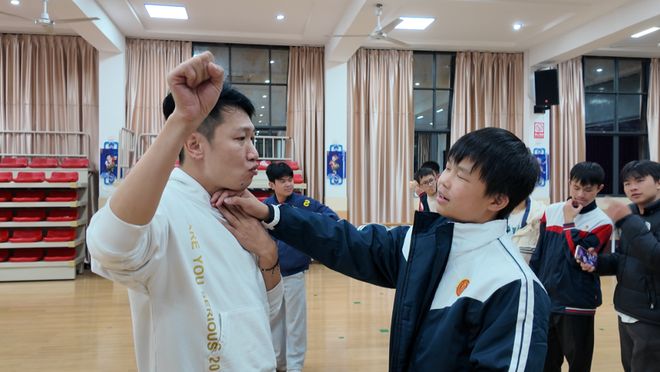
通过振动感受声音——李博(左)和桂林市聋哑学校的孩子们在做训练
“孩子会把手放在我的喉咙上,我也把手放在他们的喉咙上。我们同时发出‘啊’——空气就在掌心之间颤动。他们能感觉到我的声音,也能感受到自己试图‘接近’那种振动。那一刻,他们明白了:要唱准音高,必须让自己的声带震动我和同频。” 张咏说。
"Their music arises from their experiences and is expressed through their bodies. It answers to no aesthetics but its own, for their world does not exist on the margin — it runs in parallel to ours."
The way Zhang taught the children to sing was by tuning them to the very essence of sound — vibration. "A child would place a hand on my throat, and I would place mine on theirs. As we both made the 'ah' sound, the air between us trembled. They could feel the pulse of my voice beneath their palms, and I could feel theirs searching for it. That's when they understood: to reach the same pitch, they had to let their own vocal cords hum the way mine did. They learned to listen not with their ears, but with their bodies — to feel the resonance rising through the chest, echoing in the head, and merging into a sound that was wholly their own."
孩子们“用身体听”,用胸腔的震动、头部的回响去记忆音高。独自练习时,他们使用乐器调音器。当指针稳定在某个音上时,他们就把那一瞬身体里的震动牢牢记住。千百次重复后,肌肉记忆便代替了听觉:身体“记住”了一个音。
“在专业音乐界,这叫作‘绝对音感’——很多音乐家要练好多年。”张咏说。
每个孩子只要能唱出一个准确的音符,合在一起就能组成一首乐曲。
When practicing alone, the children used a tuning meter — the kind musicians use to fine-tune their instruments. As the needle steadied at the desired pitch, the child would memorize the vibration running through their body at that moment. They would repeat this process thousands of times, until the feeling itself became memory — until their body muscles remembered how to produce a sound that corresponded to a musical note.
"In the professional world of music, this is called absolute pitch, or perfect pitch — the ability to hit a note without any reference tone. Even trained musicians usually require years of practice to develop it," Zhang said.
"The idea is simple: if each child can sing a single note, together they can produce a full range of notes that form a piece of music. "
从山谷到大海,再到北京舞台
2017年5月,合唱团成立三年后,他们在凌云县礼堂首次公开演出。那一分钟的短曲,音准并不完美,但在张咏看来,“那些起伏如浪的‘啊’,意味着这些孩子开始踏上了生命中的潮汐——虽犹疑,却带着喜悦。”
In May 2017, just over three years after the choir was formed, its 14 members made their debut in the assembly hall of Lingyun county, performing a one-minute etude specially composed by Zhang for the occasion.
"The performance was far from perfect. But as the 'ah' sounds of varying pitches rose and fell like waves breaking on the shore, I realized that these children — there were 15 of them — had started to ride the tides of their lives — hesitantly, yet with joy," said Zhang.
两个月后,他们踏上飞往厦门的飞机参加厦门音乐节。这是孩子们第一次坐飞机、第一次进游乐园、第一次看到海。“他们不仅仅是看看,而是直接冲进去——我们一个个把他们从水里拖出来,又累又好笑,也无比快乐。”李博说。
Two months later, the children arrived in Xiamen, Fujian province, to take part in its annual music festival. Their performance, extended from one minute to three, seemed almost secondary — everything else was so astonishingly new for them. It was the children's first time on a plane, their first visit to an amusement park, and their first glimpse of the sea.
"They didn't just glance at the water — they plunged straight in, despite never having learned to swim. One by one, we had to drag them back — it was chaotic, exhausting yet utterly exhilarating," Li recalled.
厦门音乐节的现场,有来自北京中山公园音乐堂的负责人。于是,2018年8月4日,孩子们站上了中国最神圣的音乐殿堂之一。
“观众离舞台非常近——近到最后,几乎一半的人都流下了眼泪。”张咏说。这次,他们演了12分钟。
Among the audience at the choir's performance in Xiamen was a director from Beijing's Forbidden City Concert Hall. An invitation was soon extended, and on Aug 4, 2018, the children — some entering adolescence — found themselves standing on the stage of one of China's most venerated venues.
"The audience sat close to the stage — so close that by the end, nearly half were wiping away tears," Zhang recalled. This time, the piece was extended to 12 minutes.
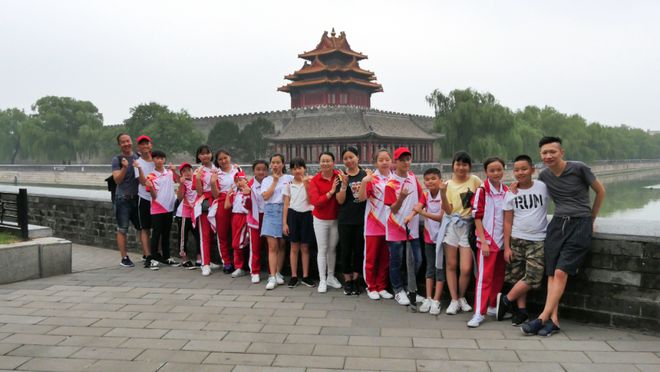
李博(右一)和张咏(左一)和合唱团的孩子们2018年在北京故宫
这场演出带来巨大的关注。“大家都说我们做的是慈善。”李博说,“但我一直想:真正的给予与被给予是谁?我们帮孩子走出世界,但他们也让我们正视自身看不见的边界,以及我们习惯逃避的脆弱。”
The Beijing concert brought a wave of public attention.
"People spoke of it as a worthy act of charity," said Li. "But I keep asking myself — who were the givers, and who were the receivers? It's true that we helped the children step beyond their enclosed world. Yet through their voices — and their disabilities — they compelled us to confront the boundaries of our perception, as well as our own quiet inability to face our limitations, which can be debilitating in itself.".
新冠疫情到来后,一切戛然而止。一些成员离开了,还有一些则升入新的学校继续求学。李博和张咏也跟了过去,在桂林市聋哑学校继续组团。
Then the coronavirus pandemic hit, bringing everything to a standstill. Some members left the choir; others, growing older, transferred from Lingyun School to a special-education high school in Guilin, a city in Guangxi, to continue their studies and learn vocational skills. Li and Zhang followed them there, settling into the new school and recruiting fresh members once the pandemic was over.
重返舞台:一次情感上的归来
今年9月,他们站在北京中山公园音乐堂的舞台上。15名成员中,有三人从2013年起便跟着他们走到今天。年龄最小的12岁,最大的21岁。
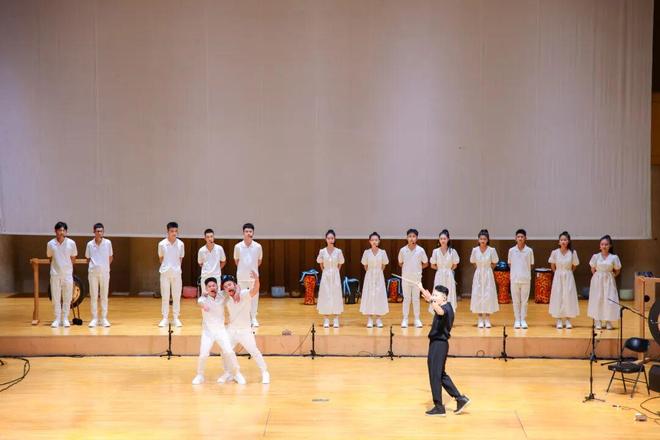
无声合唱团今天 9 月份在 北京中山公园音乐堂 演出,李博是指挥
演出前,每位观众收到一封由孩子们亲手写的信。大多数孩子形容自己“很安静”,几乎所有人都写下了一条朴素愿望:希望长大后找到一份能让父母不再辛苦的工作。
The choir's performance at Beijing's Forbidden City Concert Hall in September was an emotional comeback. Out of its 15 members, three, including Yang Weiwei, have been with the choir since 2013. The oldest member is 21, and the youngest is 12.
Before the performance began, each audience member received a printed copy of a handwritten letter from a choir member. Most described themselves as quiet, and almost all expressed a simple wish: to find a well-paying job so their parents would no longer have to work so hard.
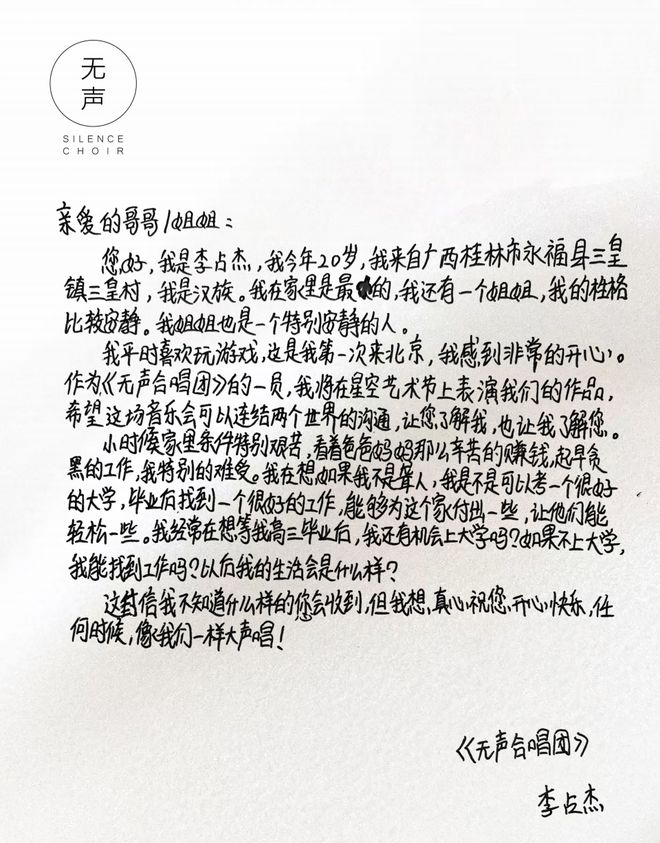
无声合唱团成员写给观众的信
许多孩子本有机会学会说话,但家庭贫困让他们无法安装人工耳蜗、负担训练和维护费用。
In fact, some choir members might have learned to speak if not for the poverty they were born into. "They couldn't afford a cochlear implant — and even if they could, the cost of speech training and ongoing maintenance would still be far beyond their families' means," Zhang said.
演出持续一小时,包含手语作品,但情感核心仍是那一声声“啊”。随着演出推进,音乐逐渐明亮,节奏加快,歌声轻快跳跃,宛如阳光在河面闪烁。
“那是孩子们嬉戏、奔跑的样子给了我灵感。”张咏说。
The performance lasted an hour and included pieces performed in sign language, though the singing — accompanied by Zhang's specially composed music titled the Trilogy of Silence — remained its emotional core. As the concert unfolded, the music gradually brightened; its tempo quickened, and the singing began to bubble and skip like sunlight dancing over a river. "It's directly inspired by the children frolicking and playing with us," Zhang said.
最后,音乐奔涌到高潮——每一声“啊”都尽力拉伸、撞击着声带;整首曲子化为奔腾不息的激流,将情绪卷动至极致。
Finally, the music surged toward its crescendo. Each "ah" soared and stretched, striking against the very walls of the singers' vocal cords. The river became a roaring torrent — overflowing, resonating, and carrying everything, every strand of emotion, in its unstoppable wake.
“长久以来,聋人被称为‘聋哑人’。无声合唱团撕开了这种误解。”李博说,“他们发出的声音自己听不见,或者更准确地说,他们能‘听见’这个声音在体内的涌动。正是这个声音——曾经丢失,最终找回——让我们也看到了找到属于自己的声音的可能性。”
"For generations, deaf individuals were simply labeled 'deaf and mute'. No one paused to consider whether they could make a sound — because sound without words was deemed meaningless. The Silence Choir tears through that assumption, revealing the truth and beauty of voices long dismissed," said Li.
"Our performers cannot hear what they sing — or, to put it more precisely, they can only hear it within themselves. Yet it is their voice — once lost, but ultimately reclaimed — that led us to search for our own voices."
“无声合唱团” 这个看似矛盾的名字,其实蕴含着深刻的哲思。老子的《道德经》说:“大成若缺,其用不弊;大盈若冲,其用不穷;大直若屈,大巧若拙……大音希声。”
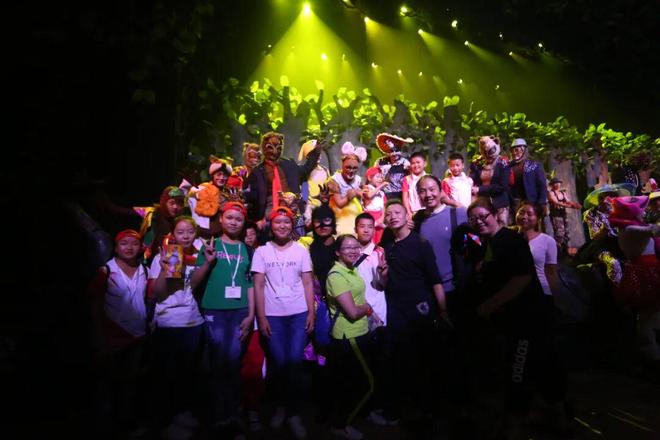
李博(前排右三)和张咏(前排右二)和合唱团的孩子们2018年来北京演出时在欢乐谷游玩
“我们唯一的愿望,就是让这些孩子认识到:他们是有创造力的个体,理应充满尊严地活着。”他表示。
For Zhang, the very name of the choir, contradictory as it appears, contains a deeply spiritual side. Laozi, philosopher and founder of Daoism who lived in the 6th century BC, once said, "True accomplishment wears the guise of incompleteness… Great eloquence hesitates; and the deepest music whispers in silence."
"All we've ever wanted," Zhang said, "is for these kids to recognize themselves as creative individuals, entitled to live their lives to the fullest."
李博记得厦门那场演出结束时,最打动他的一幕——
“最后一个音消失后,不是掌声,而是彻底的寂静。”
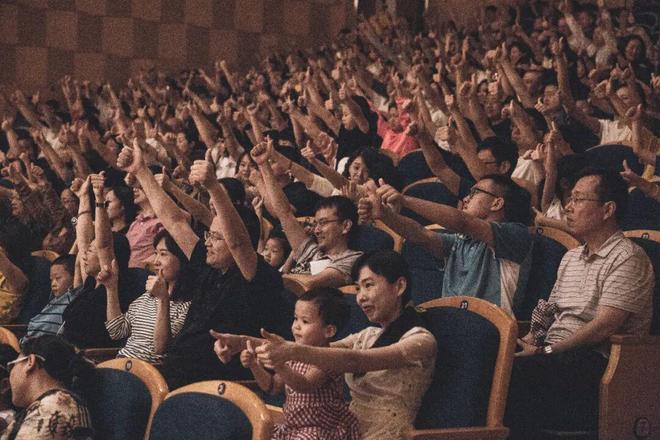
观众为无声合唱团的孩子们竖起了大拇指
“作为指挥的我背对观众等了又等,那份沉默几乎震耳欲聋。然后我转身,看见全场所有人,都竖起了大拇指。”
Li recalled a moment of profound silence at the end of the choir's performance in Xiamen.
"I was conducting on stage, my back to the audience. Normally, when the final note fades, you'd expect applause. But that time — nothing. Absolute stillness," he said.
"I waited, and the silence continued — so complete it almost rang in my ears. Then I turned around — and there they were, every single person, holding up their thumbs."
扫码听《无声三部曲》↓↓↓
记者:赵旭
跟着China Daily
精读英语新闻
“无痛”学英语,每天20分钟就够!
 晋ICP备17002471号-6


 分享给我的好友